From equations to ice sheets: how an interest in maths and physics led Dr Inès Otosaka to Antarctica and Greenland
4th March 2026
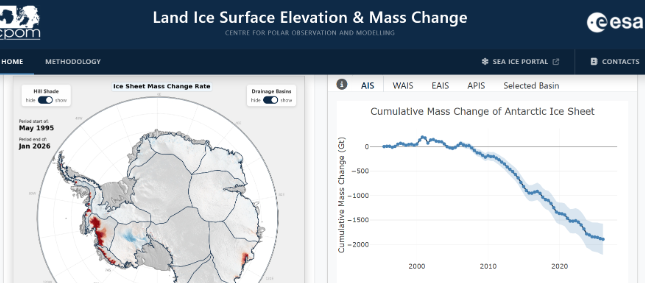
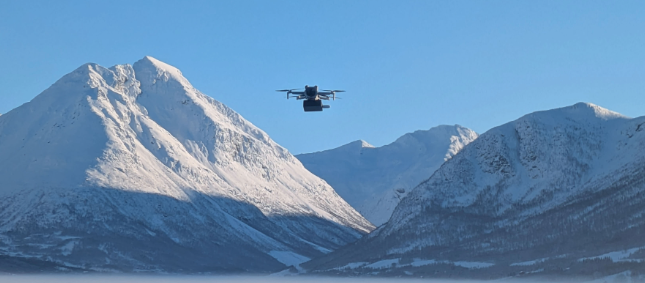
Dr Inès Otosaka is an Assistant Professor at Northumbria University in Newcastle. Her research focuses on using satellite and airborne altimetry data over the Greenland and Antarctic ice sheets to detect and interpret changes in their elevation, volume, and mass and estimate their contribution to sea level rise.
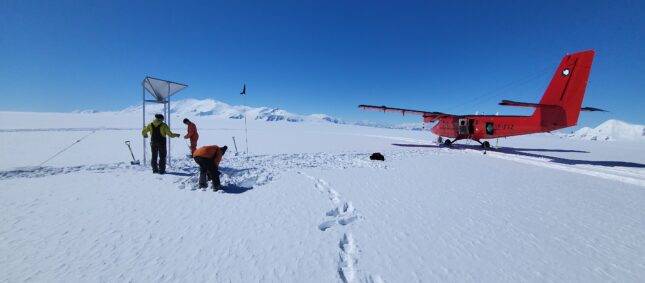
She’s also had the chance to visit these incredible places, joining fieldwork expeditions in the Arctic and Antarctic.
At school she has no idea that this career in polar science lay ahead of her. It all started with a French Baccalauréat and a talent for maths and physics.
Yesterday, as part of Mars Day 2026, organised by STEM Learning, ESERO-UK, The European Space Agency and the UK Space Agency, she shared her experience of building a career in polar science with young people across the UK.
After her Baccalauréat (the equivalent of British A-Levels) she went on to Engineering School, where her studies broadened to include mechanics and computer science. The interdisciplinary nature of this study, including both maths and engineering, was excellent transferable experience that would prove useful in her career in climate science.
Everyone’s journey in science looks different. Inès’ included an internship in a factory, which gave her hands-on experience of how technical knowledge gets applied in practice, and her subsequent internship placed her in a research lab working on climate data from Argentinian vineyards. By working with real climate datasets like these, she discovered the kind of work she wanted to do.
Inès continued her academic studies, pursuing a Master’s of Science in The Built Environment, during which she studied remote sensing, spatial statistics, and sustainability. She also took on an internship in sea ice detection using satellite data at the KNMI (Royal Netherlands Meteorological Institute) which was her first real encounter with the cryosphere (the frozen parts of our planet).
From there, a PhD in Earth Observation followed, and then a CPOM Research Fellowship in land ice earth observation.
Today, Inès leads the IMBIE team, a collaboration of international scientists who have reconciled three decades of satellite measurements to provide the world’s most authoritative estimates of ice sheet mass balance and sea level rise contributions. She also leads on the ESA-funded CryoTipping project which combines satellite observations with ice sheet modelling to detect marine ice sheet instability in Antarctica.
This work helps answer some of the most pressing questions in climate science: how much are the Greenland and Antarctic ice sheets contributing to rising sea levels and when might we reach tipping points in the Antarctic? These are questions which affect all of us, now and in the future. Inès career path included engineering school, a factory floor, and a gradual move towards remote sensing and climate science. This led to her becoming a leading scientist in Earth Observation, teaching other young people with an interest in climate science through her work as an Assistant Professor. It’s a job she’s passionate about – “now I know why studying maths was so important – it’s led me to a job I love!” – she said as part of the presentation.
If you’re good at maths or physics and wondering where it might take you, the answer could be somewhere you haven’t considered yet. Ice sheets, satellites, sea level rise – it’s a long way from the classroom, but the journey can start with the subjects you enjoy at school.