A new study published today in The Cryosphere revives and refines decades-old satellite altimetry data, offering the potential for a sharper view of how Greenland and Antarctica have changed.
Led by Maya Raghunath Suryawanshi (CPOM, Lancaster University and Interdisciplinary Centre for Water Research) the researchers used current state-of-the-art techniques to reprocess ERS-1, ERS-2 and Envisat altimeter data, dating from the early 1990s. This produced more accurate records of ice sheet elevation spanning two decades which is crucial for understanding long-term trends in ice loss.
As melting polar ice sheets are a key driver of sea level rise, monitoring and assessing these huge, remote and inhospitable terrains is vital if we are going to adapt to changing sea levels in the future. Understanding how quickly they are melting, and why, depends on data from past decades.
Over the last thirty years, satellite missions have enabled scientists to map the polar regions with increasing precision. Radar altimetry works by timing how long it takes radar pulses to bounce off the ice surface and return to the satellite. This allows researchers to track changes in ice elevation and, by extension, ice mass over time as well as the processes driving change.
Methods for processing satellite altimetry data have improved and been refined over time. It is therefore important to return to previous datasets using updated techniques to improve the quality of this long-term satellite record. This enhances confidence in our record of ice sheet change, places current observations within a longer-term context, and helps inform our understanding of potential future behaviour of the ice sheets.

Image credit: Suryawanshi et al, The Cryosphere
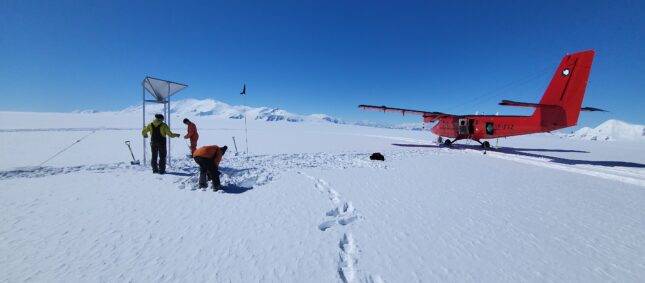
Suryawanshi and the team used the very latest techniques and algorithms when completing their processing. They then performed comprehensive assessments of these new datasets using airborne data to verify their results. The study demonstrated the improvements in data quality achieved by their new processing as they found their results were in closer agreement with this airborne data.
The team has also created a user-friendly version of this dataset which is free to access the European Space Agency website via https://earth.esa.int/eogateway/catalog/tdp-for-land-ice (ESA, 2023).
The research was performed as part of the ESA-funded Fundamental Data Records for Altimetry (FDR4ALT) project, and represents a collaboration between CPOM (led from Northumbria University), The Lancaster Environment Centre (Lancaster University), Interdisciplinary Centre for Water Research, Indian Institute of Science and Collecte Localisation Satellites.
Funding information
This study was primarily funded by the European Space Agency and UKRI NERC.
Publication information
Title: ‘New radar altimetry datasets of Greenland and Antarctic surface elevation, 1991–2012’
Authors: Maya Raghunath Suryawanshi, Malcolm McMillan, Jennifer Maddalena, Fanny Piras, Jérémie Aublanc, Jean-Alexis Daguzé, Clara Grau, and Qi Huang
DOI: https://doi.org/10.5194/tc-19-2855-2025
New Story Image credit: Suryawanshi et al, The Cryosphere
21-09-2026