Spotlight on Space: Inspiring the next generation of polar scientists with CPOM
8th October 2025
Video: CPOM
On Saturday 4 October 2025, the UK Centre for Polar Observation (CPOM) joined teams from other companies, universities and science centres at the International Centre for Life, in Newcastle upon Tyne, for their ‘Spotlight on…’ Day.
This year the focus was ‘Space’, one of our favourite topics.
Introducing polar science to young people
During the day we got the chance to meet more than 100 children and their families, all fascinated with space science and wanting to learn more. We had an array of activities ready for them, including polar science inspired puzzles and colouring activities to introduce them to the sort of animals that live in the Arctic and Antarctica. You can find these, and links to other educational resources, on this webpage.
We also introduced them to ESA’s CryoSat-2 and ESA’s ‘Paxi’ mascot, explaining how we use satellites like CryoSat-2 and NASA’s ICESat-2 to monitor the polar regions from space to see what’s happening there. We took along our ice cube tent, an incarnation of the giant ESA ice cube you can see in this video, to help the children understand how much of the ice is melting each year.
About the cube
The cube is a scale model of how much ice is lost on Earth every year if you put it all in one giant ice cube. In real life this cube of ice would be 10 cubic km in size and 1 trillion tonnes in weight! This version of the cube is only 1 cubic meter, so children can interact with it, climbing inside to meet some of the polar animals. We explained to them that the ‘real’ ice cube would be a billion times bigger than our model. The sides of the cube show exactly where the ice is melting and the volume in gigatonnes.
About the science behind the cube
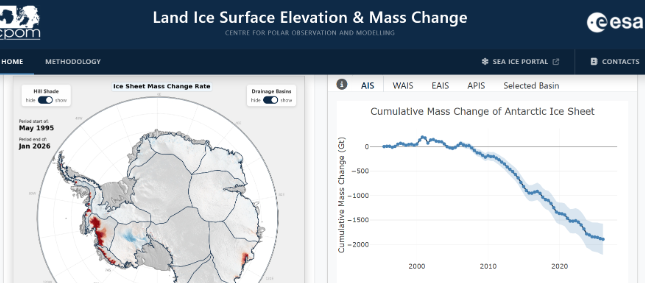
CPOM is a lead partner on ESA’s Antarctic CCI (Climate Change Initiative) project which develops methods for producing long-term and reliable climate data records of Antarctica from satellite observations. CPOM also provides scientific leadership for the Ice Sheet Mass Balance Inter-comparison Exercise (IMBIE), a community effort to reconcile satellite estimates of sea level contribution due to ice loss from the Antarctic and Greenland ice sheets. You can read more about these, and other CPOM projects, on our Projects page.
The importance of sharing our science
As Ben Rutherford-Orrock, Contemporary Science Manager, mentions in our case study video:
“Science is all about asking questions and trying to work out the answers. That could be in solving some of the biggest problems we have in the world. Some of these questions are going to take time. If we are looking at how to answer some of these questions we are going to need the next generation of scientists, technologists, engineers and maths professionals. By making science accessible we can encourage young people to think about science as a potential career for the future.”
CPOM Director for Knowledge Exchange Dr Sammie Buzzard (Northumbria University) continues:
“It’s really important for everyone to know about the science we do here at CPOM because it has implications for the whole planet. We are looking at how our polar regions are changing and where the ice is melting. This can have implications for sea level rise which is going to affect everywhere with a coast and beyond.”
This year we have met around 500 children through outreach events like this.
Of those surveyed at all of these events in 2025:
85% reported learning something new about polar science.
56% said they would consider becoming a polar scientist in the future.
We look forward to continuing to inspire the next generation of polar scientists in 2026 and beyond.