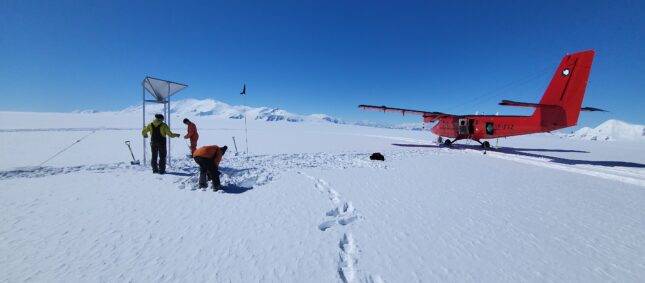
Resolute Bay is part of the Qikigtaaluk Region at the northern end of Canada’s Northwest passage. One of the coldest inhabited places on Earth, it is also the stunning location of recent fieldwork involving CPOM scientists.
In April 2025 the all-female field team of polar scientists from UCL, including Julienne Stroeve, Rosemary Willatt, Carmen Nab and Alicia Fallows, with an airborne team led by Christian Haas from AWI, visited Resolute Bay to investigate the use of Ku- and Ka-band frequency radar and different polarisations on ice and snow.
Watch the team in action in this video case study.
What is KuKa?
KuKa is a dual-frequency radar operating at Ku-band (12-18 GHz) and Ka-band (30-40 GHz) frequencies.
KuKa radar can work in two ways; estimating the distance from the sensor to a surface looking straight down (using Altimeter mode); and also when looking at an incidence angle (using Scatterometer Mode). It can collect information about the polarisation of the waves, which is referred to as ‘Polarimetric Capability’ (You can find out more about this in this paper by Stroeve et al.) Scientists have found that polarisation can help to determine snow depth on Arctic and Antarctic sea ice, which could also help with estimation of sea ice thickness.
The team tested KuKa radar at two sea ice locations, on tundra, and on the frozen freshwater Resolute Lake, towing the KuKa radar on a qamutiik (traditional Inuit sled) at all four sites.
A Magnaprobe was used to determine the snow depth at many points along the same track as the KuKa was tested. A SnowMicroPen (SMP), was used to gain information on the penetration resistance of the snow and build understanding of the snowpack formation.
The Magnaprobe is a rod-like tool used in snow research which is pushed into the snow until it encounters resistance at the ice surface, thereby measuring the snow depth. A SnowMicroPen (SMP) is a device which estimates the snow structure, strength and density, by using a sensor to measure the penetration force in high resolution at intervals, while being forced through the snow.
The team dug snow pits to help identify the snow depth, measure temperature and salinity throughout the snowpack, and to understand physical properties of the snow. They also drilled at several locations, to take measurements of the sea ice thickness and lake ice thickness.
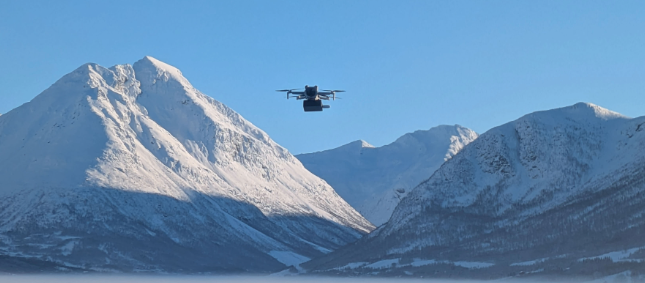
A broadband electromagnetic sensor (GEM) was used to estimate the total snow and ice thickness, and a drone and terrestrial laser scanner were used to create a 3D profile of the snow surface roughness and for images.
The team could then compare the data they gained from the Kuka device, against the measurements they took manually at the same locations.
This field campaign helps build a better understanding of how snow and ice properties affect radar signals, and retrieval of snow and ice thickness, therefore providing insights for future satellite missions such as the European Space Agency’s (ESA) upcoming CRISTAL space mission.
The concept of the CRISTAL mission is to combine Ku- and Ka-band data for simultaneous snow and ice freeboard measurements. A new technique using polarimetric information, discovered using KuKa, is also under development. This involves analysing how the electromagnetic waves scatter off a surface, which helps scientists to distinguish between the differing surfaces (ice, water or snow) in more detail.
Why is this important?
Field campaigns like these are crucial in understanding how Kuka radar can be used to provide increasingly accurate measurements of the Earth’s ice.
These missions provide information on the Earth system, including the polar regions which we use to assess ice mass balance, associated sea level rise as well as gain a clearer understanding of how global weather patterns are affected by melting ice. This scientific understanding is vital is we are to live and thrive in a changing climate.
Who funded this research?
This field campaign was part of the NERC DEFIANT project. It received funding from the European Union’s Horizon 2020 research and innovation programme via project CRiceS. This research was also supported by the Polar Continental Shelf Program. ESA NEOMI grant 4000139243/22/NL/SD supports development of the polarimetric altimetry concept.
Special Thanks
Thank you to local guide and bear guard, Sheldon, for his expert knowledge and for keeping the team safe on this fieldwork.
Glossary of terms:
Freeboard – the vertical distance between sea level and the top of the ice or snow.
A broadband EM sensor (GEM) – a geophysical electromagnetic induction sensor.
Site transects – the path (or line) along which the team recorded their observations and measurements.
Salinity – the amount of dissolved salt in the water.
Magnaprobe – a rod-like tool used in snow research which is pushed into the snow until it encounters resistance, thereby measuring the snow depth.
SnowMicroPen (SMP) – a device which measures measures the snow structure, strength and density, by using a sensor to measure the penetration force in high resolution at intervals, while being forced through the snow.
KuKa – a dual-frequency radar operating at Ku-band (12-18 GHz) and Ka-band (30-40 GHz) frequencies. KuKa radar can work in two ways; estimating the distance from the sensor to a surface (using Altimeter mode); and also measuring more uneven or rough surfaces (using Scatterometer Mode).
Polarimetric Capability – The ability of KuKa to measure how the electromagnetic waves scatter off a surface, which helps scientists to distinguish between the differing surfaces (ice, water or snow) in more detail.
NERC – Natural Environment Research Council
DEFIANT – Research Programme, led by BAS and funded by NERC – Drivers and Effects of Fluctuations in sea Ice in the ANTarctic. Read more.


Key Publications Relating to the topic
21-09-2026