UK Scientists warn of glacier ice loss in UNESCO Report
11th November 2025
This week, scientists joined the UK National Commission for UNESCO (UKNC) to launch the ‘Glaciers and Ice Sheets in a Warming World: Impacts and Outcomes’ report, edited by Professor David J. Drewry, which shares crucial UK-led scientific research on ice loss from Earth’s glaciers.
Key Findings
The report presents critical statistics on global glacier decline including:
Glaciers have lost 6,542 billion tonnes of ice since 2000, threatening the water supply of more than a billion people
Ice loss has accelerated by 36% over the past ten years, with glacier melt now accounting for approximately one-third of global sea level rise
Fifteen million people are at risk from glacier lake outburst floods, whilst up to two billion depend on water from glaciers for energy, water and food
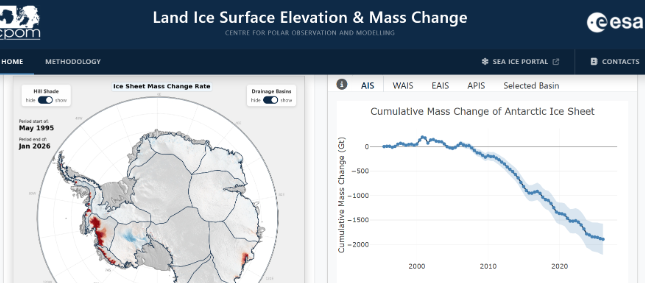
Chapter three of the report, authored by CPOM Associate Investigator in Land Ice Earth Observation Noel Gourmelen (University of Edinburgh and Earthwave Ltd) with Livia Jakob (Earthwave Ltd), explores how satellite missions monitor glacier decline from space. Using data from missions including the European Space Agency’s CryoSat-2, their chapter incorporates key findings from the Glacier Mass Balance Intercomparison Exercise (GLAMBIE) Report released earlier this year, which confirmed that since 2000, glaciers have lost 6,542 billion tonnes of ice. Their study also showed that there has been a 36% increase in loss during the second half of the time period (2012-2023) in comparison to the first half of the record (2000-2011).
About CryoSat-2
Launched in 2010, CryoSat-2 transformed our ability to monitor glacier ice from space by offering improved spatial resolution and accuracy, almost-complete polar coverage, and increased measurement density.
What is GLAMBIE?
The GLAMBIE exercise is a collaborative community effort that reconciles 233 estimates from 35 international research teams of ice mass balance from glaciers across all 19 glacierised regions worldwide. By integrating altimetry, gravimetry and DEM (Digital Elevation Model) -based approaches, the GLAMBIE team produces comprehensive and robust estimates for ice loss, which can be used by policymakers and government agencies when planning for future climate scenarios, including IPCC assessments.
Why Monitoring Glaciers Matters
Tracking glacier changes is essential for several reasons:
When glaciers melt, they contribute significantly to global sea levels, impacting millions of people worldwide
Increased glacier melting can cause glacial lakes to collapse, resulting in devastating floods
Many millions of people rely on glacier water for energy, water supplies, crops and livestock
The CRISTAL mission, part of the Copernicus Space Programme and scheduled for launch in 2027, aims to continue CryoSat-2’s legacy. As Noel Gourmelen and Livia Jakob emphasize in the report, it is vital to secure future Earth Observation missions like CRISTAL to ensure ongoing and uninterrupted accurate monitoring of Earth’s ice. Such observations and modelling of future scenarios are essential to inform decision-making around glacier preservation and to support strategies for protecting people and infrastructure from the risks posed by melting ice.
The International Year of Glacier Preservation
This report is timely! The United Nations has designated 2025 as the International Year of Glacier Preservation to highlight the importance of glaciers and to ensure that populations who rely on them, as well as those affected by glacier changes, receive the hydrological, meteorological and climate services they need.