In this Q&A, CPOM Professor Ali Banwell discusses why she was honoured to be featured in a STEM colouring book, and why representation matters so much in science careers.
What led you into your career as a polar scientist? Was there somebody or something that initially inspired you to pursue STEM?
My mum was a huge influence. She studied engineering at Cambridge when almost no women did (<1%), and later became a maths teacher, then software engineer. Her confidence in maths and physics – subjects not always ‘cool’ for girls – helped shape mine. I also grew up climbing and hiking in the UK mountains with my aunt, who sparked my curiosity about how glaciers once shaped those landscapes. Even though glaciology wasn’t taught at my school, by the time I reached university I knew I wanted to study Earth sciences, specialising in glaciology specifically.
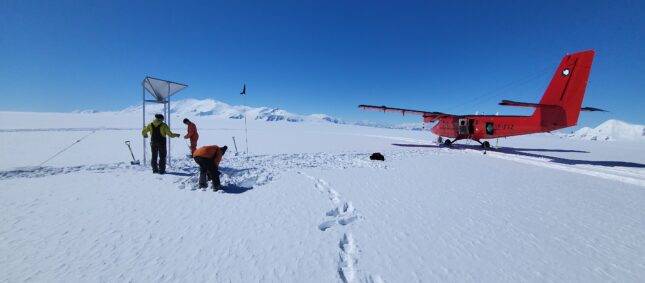
Can you describe what you’re doing in the image that inspired the drawing in the book? What’s the science behind it (in a nutshell)?

I’m drilling a deep hole into a floating glacier (an ‘ice shelf’) to install a long aluminium pole. We mount geophysical instruments on these poles, such as high-precision GPS units, weather stations, and time-lapse cameras, to measure how the glacier ice moves and changes over time, particularly in response to climate change. The photo was taken on the McMurdo Ice Shelf, close to the U.S. Antarctic research station, McMurdo.
Can you tell us a little more about your research?
Broadly, my research focusses on investigating the impact of Earth’s past and future climate on the cryosphere – so all of Earth’s icy regions – with a current focus on the Antarctic and Greenland ice sheets, including their floating ice shelves.
Specifically, I specialise in integrating satellite Earth Observation techniques, including optical, microwave, and altimetry data, with field observations to investigate ice sheet and ice shelf surface melt and hydrology, and implications of these processes for ice dynamics. I also work closely with numerical modellers to integrate our new observations and process understanding of ice dynamics into models, ultimately to help provide better forecasts of future glacier ice loss and sea level rise.
I am fortunate to have been to Antarctica six times previously, and I’ve just arrived back there now. I’m at McMurdo, the U.S. station at the edge of the Ross Ice Shelf. Unfortunately, however, I’m a glaciologist who really hates being cold… But I do love penguins!
Where do you see the biggest uncertainties or knowledge gaps in our current understanding of polar ice dynamics, and what will it take to close them?
One of the biggest uncertainties in polar ice dynamics is how quickly ice sheets and ice shelves will respond as the climate continues to warm, including the potential ‘feedbacks’ and ‘tipping points’ that could accelerate change. To reduce these uncertainties, and better constrain future sea-level rise, we need sustained, high-quality Earth Observation records from new satellite missions, supported by targeted fieldwork and modelling. We also need to rethink how we do polar science so that it is more carbon-efficient, whether through using more computationally efficient AI-based models, lower-emission fieldwork logistics, or greater international coordination to minimise our environmental footprint. Closing these knowledge gaps will require long-term investment, interdisciplinary collaboration, and a commitment to monitoring and understanding the polar regions in more sustainable ways.
What is your role at CPOM?
I have joined CPOM as a PI in Land Ice/Ice Shelf Earth Observation, and more broadly as a Professor in Glaciology within Northumbria’s School of Geography and Natural Sciences. After 7.5 years in the U.S. at the University of Colorado Boulder, I’m excited to build new collaborations and expand my research horizons within CPOM and the wider UK glaciological and environmental science communities. Working closely with CPOM’s experts in Earth Observation and modelling, across both land ice and sea ice, will strengthen my research and open up new opportunities for interdisciplinary polar science.
What does being featured in a STEM colouring book mean to you, and what advice would you give to early career researchers considering a career in this field?

I was excited to be part of this because I think one of the most meaningful ways to encourage girls of all backgrounds to pursue Science, Technology, Engineering and Maths (STEM) is by providing visible role models. In Antarctic field research in particular, female leadership is still rare, so it’s important for girls to see that women can and do lead world-class field science in these and other environments. Research shows that girls’ engagement in STEM subjects, and later women’s participation in STEM careers, often declines with age/career stage. I hope that being part of this book helps to spark that curiosity and confidence in the next generation!
You can find out more and purchase the book from the link below.
Image Credits: From STEM Super Stars: Women of Today Changing the World (KN Storycraft Press, 2025)
21-09-2026