Here are some CPOM highlight talks and posts featured at the EGU General Assembly in Vienna (3 – 8 May 2026).
Monday 4 May
Presentations
Lauren Gregoire presenting Northern Hemisphere ice-sheet dynamics during the last two deglaciations: responses to gradual and abrupt climate changes – 14:05–14:15 (CEST), Room L2.
Yiliang Ma presenting The Role of a Dynamic Greenland Ice Sheet in Future Climate: Insights from Multi-Centennial Coupled UKESM Simulations – 17:00–17:10 (CEST), Room L2.
Tuesday 5 May
Presentation
Benjamin Graves presenting High-Altitude Himalayan Meltwater Contributions Revealed by Isotopic Analysis – 11:55–12:05 (CEST), Room 3.29/30.
Wednesday 6 May
Poster
Mal McMillan’s poster on Cryo-TEMPO: a CryoSat-2 Thematic Product over Land Ice – 14:00–15:45 (CEST), Hall X5 | X5.185.
Thursday 7 May
Posters
Emily Glen’s poster Continental-scale mapping of Antarctic supraglacial hydrology using machine learning (Hall X5 | X5.235).
Luca Bianchi’s poster Modelling the Geomorphology and Hydrology of Supraglacial Meltwater Channels (Hall X5 | X5.238).
Diego Moral Pombo’s poster Optimising detection of Greenland’s active subglacial lakes with DEMs: evaluating coregistration and detrending strategies (Hall X5 | X5.246).
All at 14:00–15:45 (CEST) in Hall X5.
Friday 8 May
Presentations
Karla Boxall presenting A framework for evaluating ice-sheet-wide altimetry uncertainty estimates – 14:35–14:45 (CEST) in Room L2.
Joe Phillips presenting Extracting Swath Elevation Information from Non-Interferometric Radar Altimetry using Probabilistic Deep Learning – 14:45–14:55 (CEST) in Room L2.
Rosie Willatt presenting Polarimetric Synthetic Aperture Radar Altimeter (PoSARA): progress towards a new Earth Observation mission concept for snow depth and cryosphere remote sensing – 08:35–08:55 (CEST), Room 1.34.
Posters
Penny Coulthard’s poster Comparing stress and deformation characteristics of sea ice using continuum and discrete element models (Hall X5 | X5.222)
Danny Feltham’s poster Melting, freezing and dynamics of Arctic sea ice: pack ice versus marginal ice zone (Hall X5 | X5.223).
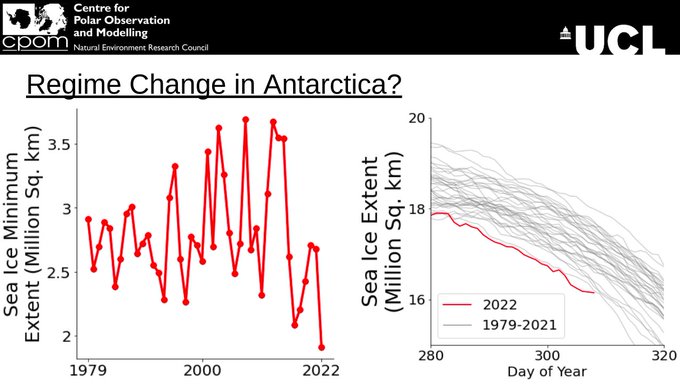
Adam Bateson’s poster Exploring the role of ocean preconditioning as a driver of Antarctic sea ice loss events (Hall X5 | X5.218)
Benjamin Mellor’s poster A regime change in Arctic sea ice growth (Hall X5 | X5.212
All at 14:00–15:45 (CEST) in Hall X5.
Please visit the EGU26 website for more information and the full programme.
Earth is losing more than a trillion tonnes of ice each year – enough to create an ice cube more than 10km high.
How do we know this?
Satellites like ESA’s CryoSat-2 mission collect crucial climate data from hundreds of miles above Earth.
Once of the challenges we face is how do we make data from space feel real for people on the ground.
Climate change and the research behind it can often feel distant and abstract, but the impacts are immediate and global.
That’s why researchers, space agencies and climate change organisations are getting creative, transforming complex information into experiences that resonate with people outside the scientific community and inspire action from Governments and government agencies.
This International Day of Climate Action, we’re sharing some of the ways that creativity has been used to share environmental science stories in 2025.
Visual storytelling from space
ESA, with Planetary Visions, have partnered to create videos that visualise the research carried out by the UK Centre for Polar Observation and Modelling and other research groups.
Here are some examples:
This animation, featuring research led by CPOM PhD Researcher Nitin Ravinder, shows the thinning of the Greenland ice sheet between 2010 and 2023.
Video Credit: ESA / Planetary Visions / CPOM
And this animation shows something surprising discovered by CPOM Researchers from Lancaster University this year – a subglacial flood bursting through the ice sheet.
Video Credit: ESA/CPOM/Planetary Visions
Stepping inside a year’s worth of ice loss: The Giant Ice Cube
How much ice is a trillion tonnes? CPOM created a 3D, explorable model to help answer this question.
Dr Tom Slater’s research has been transformed into an interactive experience that has travelled across the country, letting school children ‘step into’ a year’s worth of ice loss.
Of those surveyed at our outreach events 85% said they learned something new and 56% said they would consider becoming polar scientists.
Watch this video about why science outreach work is inspiring the next generation of environmental scientists.
Video: CPOM
Using poetry and art to bring science to life
ESA collaborated with artist Jamie Perera to create a multi-sensory installation that transforms satellite data into art. Using poetry penned by ESA’s Peter Bickerton and sonification (turning data into sound) the installation at this year’s Living Planet Symposium shares the science behind the EarthCARE Earth Explorer satellite mission, which gathers data on clouds and aerosols.
Video: ESA
Hear more from Peter Bickerton on how ESA uses creativity to share their science and why this is important
In this short interview, Peter Bickerton, talks about how he uses creativity to tap into people’s imaginations while sharing crucial climate and environmental data derived from earth explorer satellites.
Video credit: CPOM
Bonus: We also have a video of Peter’s 15-year anniversary poem about one of our favourite satellites CryoSat-2!
Video credit: CPOM
Behind the scenes on scientific fieldwork
Some of the most compelling climate science happens in the world’s most remote places where most people will never visit.
That’s why CPOM and programmes like BIOPOLE, led by the British Antarctic Survey (BAS) bring the Arctic and Antarctic to audiences through video content.
In this video filmed aboard RSS Sir David Attenborough, viewers get to see the science in action.
National Capability science like this spans decades of monitoring and measuring, but these glimpses behind the scenes remind us that climate data comes from real people doing remarkable work in extreme conditions.
Video: CPOM
A castle becomes a canvas
This November, CPOM PhD researcher Diego Moral Pombo in partnership with photographer and media specialist James Hooton, will transform Lancaster Castle into a stunning polar science showcase.
Their light installation projected onto Lancaster Castle’s historic John O’Gaunt Gate will bring ice sheets and glaciers to life, visualizing the hidden dynamics happening deep beneath the ice.
By placing climate science in a public place, the installation will invite visitors to the Light Up Lancaster festival to consider how the Earth’s ice sheets are changing, and why.
From research to action
The satellite data shows that Earth’s ice is melting, but data alone rarely inspires action. By transforming complex satellite observations into giant ice cubes, poetry, art installations, and visual stories help people understand that climate change is happening now, is measurable from space, and is affecting communities worldwide.
This International Day of Climate Action, we’re reminded that inspiring climate action requires both science and imaginative communication.
When the science community makes space-based climate data tangible, accessible and engaging, we empower everyone, from schoolchildren to policymakers to understand the challenge, and be part of the solution.
On Saturday 4 October 2025, the UK Centre for Polar Observation (CPOM) joined teams from other companies, universities and science centres at the International Centre for Life, in Newcastle upon Tyne, for their ‘Spotlight on…’ Day.
This year the focus was ‘Space’, one of our favourite topics.
Introducing polar science to young people
During the day we got the chance to meet more than 100 children and their families, all fascinated with space science and wanting to learn more. We had an array of activities ready for them, including polar science inspired puzzles and colouring activities to introduce them to the sort of animals that live in the Arctic and Antarctica. You can find these, and links to other educational resources, on this webpage.
We also introduced them to ESA’s CryoSat-2 and ESA’s ‘Paxi’ mascot, explaining how we use satellites like CryoSat-2 and NASA’s ICESat-2 to monitor the polar regions from space to see what’s happening there. We took along our ice cube tent, an incarnation of the giant ESA ice cube you can see in this video, to help the children understand how much of the ice is melting each year.
About the cube
The cube is a scale model of how much ice is lost on Earth every year if you put it all in one giant ice cube. In real life this cube of ice would be 10 cubic km in size and 1 trillion tonnes in weight! This version of the cube is only 1 cubic meter, so children can interact with it, climbing inside to meet some of the polar animals. We explained to them that the ‘real’ ice cube would be a billion times bigger than our model. The sides of the cube show exactly where the ice is melting and the volume in gigatonnes.
About the science behind the cube
CPOM is a lead partner on ESA’s Antarctic CCI (Climate Change Initiative) project which develops methods for producing long-term and reliable climate data records of Antarctica from satellite observations. CPOM also provides scientific leadership for the Ice Sheet Mass Balance Inter-comparison Exercise (IMBIE), a community effort to reconcile satellite estimates of sea level contribution due to ice loss from the Antarctic and Greenland ice sheets. You can read more about these, and other CPOM projects, on our Projects page.
The importance of sharing our science
As Ben Rutherford-Orrock, Contemporary Science Manager, mentions in our case study video:
“Science is all about asking questions and trying to work out the answers. That could be in solving some of the biggest problems we have in the world. Some of these questions are going to take time. If we are looking at how to answer some of these questions we are going to need the next generation of scientists, technologists, engineers and maths professionals. By making science accessible we can encourage young people to think about science as a potential career for the future.”
CPOM Director for Knowledge Exchange Dr Sammie Buzzard (Northumbria University) continues:
“It’s really important for everyone to know about the science we do here at CPOM because it has implications for the whole planet. We are looking at how our polar regions are changing and where the ice is melting. This can have implications for sea level rise which is going to affect everywhere with a coast and beyond.”
This year we have met around 500 children through outreach events like this.
Of those surveyed at all of these events in 2025:
85% reported learning something new about polar science.
56% said they would consider becoming a polar scientist in the future.
We look forward to continuing to inspire the next generation of polar scientists in 2026 and beyond.
CPOM Director, Professor Andy Shepherd (University of Leeds) features in a STEM Learning episode on Protecting Our Ice, its now available to watch online and includes a live link up with BAS scientists from the bottom of the Earth at Rothera Research Station in Antarctica discussing their research, a live introduction from the Captain onboard the RRS Sir David Attenborough and exclusive interviews and live Q&A with the Executive Producer and Series Producer of Frozen Planet II.
PhD researcher, Robbie Mallett (UCL) attended COP27 in Sharm El Sheikh, Egypt, with the International Cryosphere Climate Initiative. During the conference he gave talks and appeared on panels in the Cryosphere Pavilion. As well as running the pavilion, the ICCI released the 2022 State of The Cryosphere Report, which Robbie helped to launch to the media and COP participants.
Robbie and the ICCI also campaigned for greater recognition of the cryosphere in COP negotiations. This year the cryosphere was specifically mentioned in the conference’s cover declaration for the first time, and the ICCI coordinated a new multinational coalition, named the Ambition on Melting Ice https://iccinet.org/ambition-on-melting-ice/
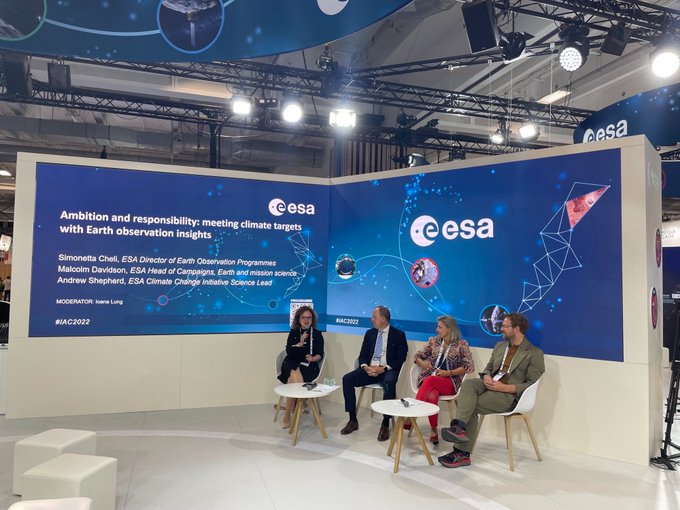
CPOM Director, Professor Andy Shepherd (University of Leeds) joined Simonetta Cheli, ESA’s Programmes and Head of ESRIN (ESA establishment in Italy) and co at the IAC2022 to discuss how ESA is preparing to address climate change. You can also watch Andy Shepherd answering how we raise awareness on climate change and what can scientists do?
“We need to tell people good news stories about climate recovery. There’s hope!”